The Refugee Law Lab undertakes research and advocacy about legal analytics, artificial intelligence, and new border control technologies that impact refugees and other non-citizens. We are based in Toronto, Canada, and are co-hosted by York University’s Centre for Refugee Studies & Osgoode Hall Law School.
Bill C-12 bars refugee claims made more in Canada than a year after arrival. Applying computational methods to nearly 29,000 decisions, this study finds gender and SOGIE claimants are overrepresented among late claims, and the hearings and appeals the bar removes have protected them most.
The AI Resist List
We and AI, the DAIR Institute, journalist Karen Hao, and the RLL have built The AI Resist List a comprehensive database that highlights global efforts to challenge AI. This project is a world-wide resource that shows how anyone can resist, refuse, reimagine, and reclaim AI technologies and counter the dominant narratives that their development and Big Tech’s increasing power is inevitable.
New Report on Tech & Alternatives to Detention
A new report from UNSW Sydney’s Kaldor Centre for International Refugee Law, the International Detention Coalition and the RLL investigates alternatives to detention technologies — and their human rights impacts. Report available here.
Featured Projects
Visit our projects page for links to all of our research projects.
Monitors surveillance technologies, automation, and the use of artificial intelligence to screen, track, and make decisions about people on the move -- with a fellowship program to support work from-the-ground-up.
Portal for visualizing data about outcomes in Canada's Refugee determination system at both the Federal Court and Immigration and Refugee Board levels, including recognition rates of decision-makers.
Reporter for positive Immigration and Refugee Board refugee decisions obtained via Access to Information procedures, aiming to counteract bias towards negative decisions in existing published case law.
Annual statistics about refugee claim recognition rates, obtained via Access to Information procedures from Canada's Immigration and Refugee Board, broken down by individual decision-maker.
Open-source bulk datasets with the full text of Canadian court and tribunal cases, legislation and regulations. Available for programmatic access in JSON, parquet & Hugging Face Dataset formats.
Data and corporate documents related to the removal of people with a refused refugee claim, obtained via Access to Information procedures from Canada Border Services Agency (CBSA) and Immigration Refugees and Citizenship Canada (IRCC).
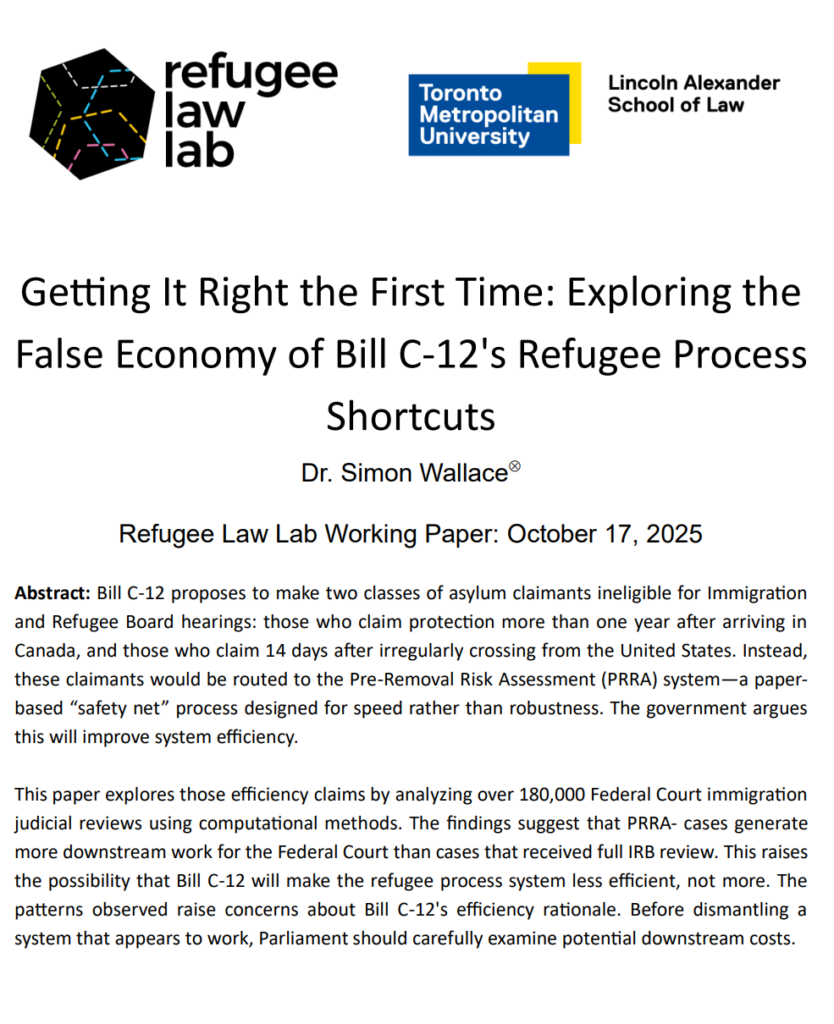
The Refugee Law Lab has produced a working paper that examines 180,000 Federal Court of Canada judicial reviews using computational methods to scrutinize the claim that Pre-Removal Risk Assessments are more efficient than Immigration and Refugee Board decision-making — a claim used to justify expanding limits on access to the IRB in Bill C-12. The paper, written by Simon Wallace, argues that the data does not support this claim.
Based on years of researching borderlands across the world, lawyer and anthropologist Petra Molnar’s The Walls Have Eyes is a truly global story—a dystopian vision turned reality, where your body is your passport and matters of life and death are determined by algorithm. Examining how technology is being deployed by governments on the world’s most vulnerable with little regulation, Molnar also shows us how borders are now big business, with defense contractors and tech start-ups alike scrambling to capture this highly profitable market.
The article uses machine learning processes to extract data from thousands of online Federal Court (Canada) dockets to explore patterns in stay of removal decisions. The article argues that outcomes in stays of removal appear to hinge in part on the luck of the draw, on which judge is assigned to hear the case. The article demonstrates that technologies that are increasingly used to enhance the power of the state at the expense of marginalized migrants can instead be used to scrutinize legal decision-making in the immigration law field, hopefully in ways that enhance the rights of migrants.